
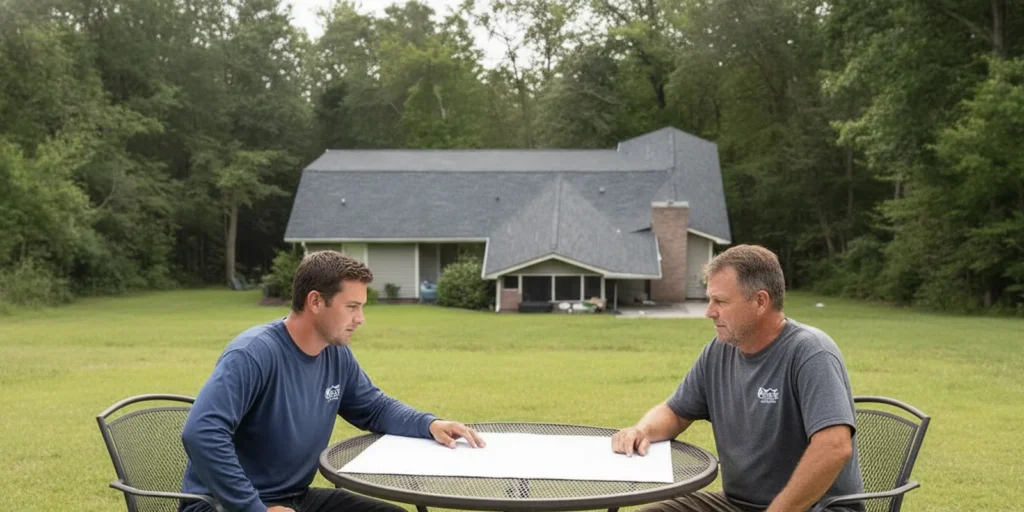
Roof financing for replacement can help a homeowner consider an eligible roof project without treating the full project cost as an immediate cash payment. But financing is not a roofing recommendation, a guaranteed approval, or a promise that a particular payment will fit a household budget. For homeowners in the coastal Grand Strand, the practical first step is to understand the roof’s condition and likely scope, then ask what financing may be available for the specific replacement project.
Call to discuss a roof inspection
What should a homeowner in the coastal Grand Strand know about roof financing for replacement before contacting a roofer?
Start with a simple distinction: a roof contractor evaluates the roof and explains possible work; a lender determines whether financing is available and on what terms. Those are related conversations, but they are not the same decision. A roof inspection may conclude that a localized repair is suitable, that monitoring or further evaluation makes sense, or that replacement should be considered. Financing only becomes relevant to a replacement conversation if the project and homeowner meet the applicable lender requirements.
Coastline Roofing offers financing for qualified homeowners on eligible roof replacement projects, subject to lender approval and terms. That does not establish approval, a particular loan amount, interest rate, repayment period, down payment, or monthly payment. Those details must come from the lender for the homeowner’s own application. Financing is not described for inspections, repairs, or commercial work.
Before focusing on a monthly payment, ask what work the roof actually needs. A sound comparison begins with the condition of the existing roof, the proposed replacement scope, and the written estimate. Homeowners can learn about the contractor’s roof replacement process while preparing questions. The page and the inspection discussion can help frame the work; neither substitutes for reviewing lender documents.
This distinction matters in coastal South Carolina and southeastern coastal North Carolina, where a roof may face wind, rain, salt air, and storm-related concerns. Those conditions do not, by themselves, prove that a roof needs replacement or make financing appropriate. A professional assessment should connect observed conditions to a specific recommendation rather than treating age or a general concern as a reason to replace.
Why separate the roofing decision from the financing decision?
It is easy to begin with the question, “What could the payment be?” That question is understandable, but it cannot establish whether replacement is the right scope. First determine what is known about the roof. Then review the proposed work. After that, evaluate financing terms independently. Following that sequence helps keep a household from comparing an attractive payment against an unclear project.
A financing offer also does not establish the quality or necessity of the roofing work. A lender may review an application according to its own criteria, while the roofer assesses the building and prepares a scope. Homeowners should understand each document on its own terms: the roofing proposal describes work and price; lender paperwork describes a financial agreement. Ask questions before signing either one.
- Roof condition: What was observed, where was it observed, and what could not be inspected?
- Recommended scope: Is a repair suitable, is more evaluation needed, or is replacement being recommended? Why?
- Project estimate: What work and materials are included, and what conditions could change the scope?
- Financing: Is the project eligible, who provides the financing details, and what are the actual terms offered to the applicant?
- Household fit: Can the household evaluate the full obligation, not only a possible installment, alongside other expenses?
For independent information about understanding credit and loan terms, homeowners can consult the U.S. Consumer Financial Protection Bureau at consumerfinance.gov. Use lender-provided documents for the actual offer. General consumer resources do not decide whether a roof needs replacement or determine the terms of a particular financing plan.
What does a roof assessment tell you before you consider financing?
An assessment helps establish the problem and potential next step. Visible staining indoors, missing or displaced roofing material, a leak, or signs of storm impact can prompt an inspection, but a visible symptom does not always show the full cause. Water may travel before it appears inside. A roof professional can examine accessible components, identify visible concerns, document findings, and explain whether the next step appears to be repair, additional evaluation, monitoring, or replacement.
Coastline describes an inspection process that considers accessible roofing materials, flashing, penetrations, edges, drainage, and nearby problem areas. Photos and findings can help make the discussion more concrete. Still, access, weather, roof design, and concealed conditions limit what can be confirmed during an initial visit. A photo records an observed condition; it does not necessarily identify every underlying cause.
If a localized defect is found and the broader roof remains serviceable, repair may be a reasonable option. If conditions are more extensive, replacement may be discussed. A careful recommendation should explain why the scope fits the observed condition. Roof age alone is not enough to establish that replacement is necessary. Ask what evidence supports the recommendation and what uncertainty remains.
Homeowners can review the company’s roof inspection information before contacting a roofer. If the concern appears limited, see the details on roof repair and leak diagnosis as well. These service pages provide context; the condition of an individual roof still needs to be evaluated on its own.
When might repair be more appropriate than replacement?
Financing should not push a homeowner toward a larger project when a repair is suitable. A localized problem may sometimes be corrected without replacing the full roof. The decision depends on the source and extent of the issue, the surrounding materials, access, and the general condition of the roof. A roofer should explain whether the affected area can be repaired and what limitations a repair may leave.
Ask whether the proposed repair addresses the likely source of the leak or damage, whether nearby components may also need attention, and whether further assessment is recommended. If replacement is proposed instead, ask why repair would not be a sound solution. The answer should relate to the evidence and condition, rather than a blanket statement that every older roof must be replaced.
There can be uncertainty. A repair may reveal additional damage, or a roof may have conditions that cannot be fully assessed until work opens an area. The contractor should describe known limits and how newly observed conditions would be discussed. Do not assume that a current estimate covers every concealed condition unless the document says so.
For a leak or localized damage, the relevant conversation may be about repair rather than financing. A repair is not covered by the replacement financing description provided here. Ask the contractor to clarify the service scope and confirm any fee in writing before proceeding. Do not let a financing discussion obscure the more basic question of what work is justified.
When may replacement enter the conversation?
Replacement may be considered when the roof’s condition or extent of damage makes a limited repair unsuitable, or when a broader project is otherwise recommended after assessment. The specific reasons depend on the roof. A homeowner should expect an explanation of what was observed, what areas are affected, why a repair is not the preferred scope if that is the recommendation, and what the replacement would include.
Residential replacement options described by Coastline include asphalt shingles and metal roofing. Choosing a system is a separate decision from determining whether replacement is needed. The choice can involve the home’s design, project scope, materials, installation details, and the homeowner’s priorities. Do not select a system based only on a short description or assume that any one material is right for every coastal property.
A replacement estimate depends on factors such as roof size and complexity, system choice, and the condition of the deck after tear-off. Hidden deck repairs may affect scope. Weather and material availability can also affect scheduling. A residential job may be described as taking a few days under some conditions, but that is not a guarantee for every home or a commitment about when a project can start. Commercial timelines differ and are not covered by this homeowner guide.
Read the proposal carefully. It should make clear what is included, what system and components are being proposed, how tear-off and cleanup are addressed, and how additional work would be communicated if hidden conditions are discovered. If a document uses terms you do not understand, ask for plain-language clarification before making a decision.
What does “eligible replacement project” mean?
“Eligible” is a qualification, not a promise. Coastline’s available information describes financing for qualified homeowners on eligible roof replacements, subject to lender approval and terms. It does not identify a universal eligibility checklist or state that every homeowner, roof, or project qualifies. The lender determines its requirements, and the project must fit the applicable program.
Do not infer eligibility from living in the service area, owning a home, receiving a replacement estimate, or having an urgent roof concern. Do not assume financing applies to a repair, inspection, commercial building, multifamily property, or HOA project. The available customer information limits the financing statement to qualified homeowners and eligible roof replacements. Ask directly whether the specific project can be considered, and have the lender explain who may apply and what documentation is needed.
Eligibility may depend on factors that only the lender can confirm. A roofer cannot promise an approval decision or terms. Likewise, a lender’s willingness to consider an application does not establish that a replacement is the right roofing scope. Keep the questions separate and get the answer from the party responsible for it.
If an applicant does not qualify, or the project is not eligible, ask what alternatives are available to the homeowner, but do not assume an alternative will be offered. You might discuss the roofing scope, timing, and options with the contractor, then review household budgeting options independently. Avoid signing a roofing agreement on the assumption that a financing application will be approved.
Which financing details should you confirm with the lender?
Only a lender can explain the actual terms for an applicant. Before accepting an offer, request the applicable documents and review the full obligation. A headline payment or verbal description is not enough to compare financial options. Make sure the figures and conditions in the documents match what you believe you were told.
- Who is the lender? Identify the company providing the financing and the party responsible for questions, statements, and servicing.
- What is the amount financed? Confirm the amount and what project charges, if any, are included. Compare it with the roofing proposal rather than assuming they are identical.
- What is the interest rate and annual percentage rate, if applicable? Ask the lender to explain the applicable rate, how it is presented, and whether it can change.
- What is the repayment period? Confirm the number and timing of payments and the total amount expected over the repayment period as described in the paperwork.
- Are there fees or other charges? Review origination, late, returned-payment, or other applicable charges. Ask how they are applied.
- Is there a promotional or deferred-interest feature? If so, understand the exact conditions, deadlines, and consequences described in the lender’s documents. Do not rely on a shorthand explanation.
- Can payments be made early? Ask whether prepayment is allowed and whether any charge or condition applies.
- When does repayment begin? Confirm the first payment date and whether any timing depends on project completion or another event.
- What happens if the project changes? Ask how an estimate adjustment, cancellation, or change in scope affects the financing agreement.
- What happens if a payment is late? Review late charges, consequences, and the lender’s process in the actual documents.
This list is a set of questions, not a description of Coastline’s financing terms. The business has not provided a lender name, interest rate, term, down payment, or approval criteria in the information available for this article. Do not treat any example or estimate from another source as the terms of a Coastline-related offer.
Ask for enough time to read the documents and compare them with your household budget. If you need clarification, ask the lender in writing or speak with an appropriate independent financial professional. Do not sign a financial agreement you do not understand.
How can you compare a monthly payment with the total obligation?
A monthly payment can make a project easier to picture, but it does not show the complete cost of borrowing by itself. The repayment period, fees, rates, and any conditions all matter. Two offers with similar monthly payments can differ in total repayment, duration, or other terms. Compare the full written agreement, not just one figure.
Use a household budget that reflects ordinary expenses and potential unexpected costs. Consider whether the payment remains manageable alongside utilities, insurance, taxes, other debts, savings needs, and routine home maintenance. The right calculation is personal. A payment that appears manageable in isolation may not fit when combined with existing obligations.
Keep project scope in view as well. If one proposal covers different materials, components, or repair allowances than another, the financing comparison is not like-for-like. First understand what the roof proposals include. Then compare available financial arrangements for the same or clearly explained scope. Ask a contractor to clarify proposal differences; ask the lender to explain financing differences.
A useful personal worksheet can include the amount financed, the payment amount and frequency, the number of payments, total repayment as stated by the lender, applicable fees, rate information, and any conditions. Leave a blank for questions that have not been answered. Do not fill those blanks with guesses.
How do you compare roofing proposals fairly?
Financing is only one part of a replacement decision. A written proposal should give you enough detail to understand the work. When reviewing proposals, compare the scope and assumptions before comparing payment options. A smaller proposed payment may simply reflect a different scope, different financial terms, or a longer repayment period.
Look for a clear description of the roofing system, tear-off, underlayment or other included components, flashing and penetrations, disposal, protection of the property, cleanup, and the handling of exposed deck issues. The exact components depend on the project. Ask whether the proposal identifies exclusions, allowances, or conditions that could lead to additional work.
Ask how observations and changes will be documented. Coastline describes photo documentation, oversight of authorized work, and property protection and cleanup as part of its operating approach. Ask how those practices apply to the proposed job and what communication you should expect. Do not infer a specific schedule or scope that is not in the written proposal.
Warranty information should also be specific to the proposed system. Workmanship coverage varies by installed roof system, alongside applicable manufacturer material warranties. There is no single duration that can be stated for every project here. Ask for the applicable warranty terms in writing, including what is covered, exclusions, any required maintenance, and the process for raising a concern. A contractor credential does not by itself establish a universal warranty duration or a resilience designation.
For a replacement discussion, the roof replacement service page is a useful place to start. It should be followed by a property-specific explanation and a written proposal. A website overview cannot determine the exact cost or system for an individual roof.
What if storm damage or insurance is part of the situation?
Storm damage can make a roof replacement conversation feel urgent, especially when water is entering the home or materials are visibly displaced. Begin by addressing immediate safety and limiting further damage where it can be done safely. Do not climb onto a roof or enter an unsafe area to inspect it yourself. Contact an appropriate professional if active conditions require attention.
A storm assessment can document visible conditions and recommended roofing work. Coastline can document visible damage and recommended work, but the insurance carrier decides coverage. A roofing assessment is not an insurance coverage decision, and no contractor can promise that a carrier will approve a claim. Keep photographs, inspection notes, estimates, and insurer communications organized, and ask the carrier what documentation it needs.
Do not assume that an insurance claim will pay for a replacement or that a particular financing offer depends on claim proceeds. Ask the carrier about coverage directly and the lender about financing directly. If there is uncertainty about who is responsible for a decision, clarify it before signing paperwork or authorizing work.
For storm-related roof concerns, Coastline’s storm damage roofing information explains the assessment context. Urgent repair needs should be discussed as roofing needs; emergency language does not establish 24-hour dispatch or a guaranteed response time.
What should a homeowner gather before contacting a roofer?
You do not need a complete technical diagnosis before calling. A few practical details help a roofer understand the concern and prepare for a useful conversation.
- Property address and the best public contact number for a return call.
- A short description of the issue, including when it began and whether it is ongoing.
- Locations of visible stains, leaks, missing materials, or other concerns, if known.
- Photos taken safely from the ground or indoors, if available. Do not climb to create photos.
- Any known prior roof work, repairs, or inspection records, without assuming those records are complete.
- Whether the concern followed a storm and whether an insurance claim has been opened, if applicable.
- Questions about the desired timeframe, access, household concerns, and how the assessment will be documented.
For a replacement discussion, also note what matters most to you: understanding available system options, minimizing disruption, learning about project stages, or getting a clear explanation of possible deck repairs. These priorities help guide the conversation but do not determine what the roof needs.
When speaking with Coastline, scheduling is handled by a person. A request to schedule an inspection is a request for follow-up, not an automatically reserved appointment time. Confirm the timing directly rather than assuming a calendar slot has been booked.
What questions can you ask during the inspection conversation?
A useful conversation is specific and unhurried. You can ask the roofer to distinguish what was directly observed from what remains uncertain. If replacement is recommended, ask for the reasons in plain language and request that the recommendation connect to the roof’s actual condition.
- What areas and components were inspected, and were any areas inaccessible?
- What findings are documented in photos, and what do those photos show?
- Does the condition appear localized, or are there broader concerns?
- Would a repair be suitable? If not, what makes replacement the more appropriate scope?
- Is more evaluation needed before deciding?
- What is included in the proposed replacement, and what is excluded?
- How might exposed deck condition affect the scope after tear-off?
- How will a change in scope be explained and approved?
- Which system-specific warranty terms apply, and where can I read them?
- Is this particular project eligible to be considered for financing, and who can provide the lender’s current terms?
Take notes and ask for the estimate and relevant documents in writing. If you receive multiple proposals, request clarification on differences rather than assuming each uses the same materials or scope. You are entitled to understand what is proposed before deciding how to proceed.
What should you avoid assuming about financing?
Several assumptions can create confusion. Financing is not automatic just because a contractor mentions it. It is not necessarily available to every homeowner, every property, or every project. A lender’s decision and terms are not known until the lender evaluates the application and communicates its offer.
It is also not a substitute for an inspection or an independent reason to replace a roof. An older roof may be serviceable; a newer roof may have a localized issue. The observed condition and appropriate scope matter more than a general rule based on age.
Do not assume that a displayed payment includes every fee or reflects the total amount repaid. Do not assume that a promotional description means interest is waived in every circumstance. Read the lender’s documents and ask about conditions, deadlines, and what happens if requirements are not met.
Do not assume insurance will cover a storm-related replacement. The carrier determines coverage. Do not assume that a financing application has been approved until the lender confirms the decision, and do not authorize work on the assumption that an unapproved application will later be accepted.
Finally, do not assume every roofing estimate is the same. Differences in materials, tear-off, flashing, protection, cleanup, deck repair provisions, and warranty terms can affect what a proposal means. Compare details before comparing totals.
How does coastal location affect the questions to ask?
Coastal properties can experience wind-driven rain, salt-laden air, humidity, and storm exposure. These conditions make a careful assessment and clear installation scope important, but they do not establish a universal material choice or guarantee a specific roof lifespan. A home’s exposure, roof design, existing materials, and maintenance history all matter.
For homeowners in Myrtle Beach, North Myrtle Beach, Little River, Longs, and Conway, ask how the proposed system and details suit the particular roof. Homeowners elsewhere in southeastern coastal North Carolina should similarly ask for a project-specific explanation. Do not rely on broad claims that a product is automatically best for every coastal property.
Ask how the contractor will address water-shedding details, flashing, penetrations, edges, and drainage as relevant to the property. Ask what protection and cleanup are included, and how completed work will be reviewed. These are practical questions, not a guarantee of performance under every storm or weather event.
Consider maintenance and observation after installation as well. A roof should be monitored according to its needs; no single inspection frequency or maintenance package is stated here. Ask what the contractor recommends for the specific system and what signs should prompt a call.
Can financing be used for a repair, inspection, or commercial roof?
The financing information available for Coastline is limited to qualified homeowners and eligible roof replacement projects, subject to lender approval and terms. It does not describe financing for inspections, repairs, commercial roofing, multifamily properties, or HOA projects. Do not assume those project types qualify.
A commercial property owner or manager should discuss the building’s roofing needs and proposal separately. Commercial systems, building use, access, and work planning can differ from residential replacement. The available financing statement does not extend to commercial work, and no commercial financing terms are established here.
Likewise, a homeowner seeking only an inspection or repair should ask about that service directly rather than treating replacement financing as relevant. First explain the concern, then determine what kind of work is recommended. If a replacement is eventually proposed, ask whether that specific project may be eligible and have the lender confirm the details.
What if the homeowner wants to wait before replacing?
Waiting can be reasonable in some situations, but only a property-specific assessment can help explain the risks and options. Ask whether the roof can be monitored, what signs would warrant prompt attention, and whether a temporary or localized repair may be suitable. If the roofer identifies an active leak or safety concern, ask what practical next step is appropriate.
Do not delay an urgent repair solely to pursue financing for a replacement that has not been confirmed as necessary. Conversely, do not rush into a large project based only on general anxiety about storms. A clear explanation of current condition, repair options, and consequences of waiting can help the homeowner make an informed choice.
If you decide to seek financing, the project estimate and the lender’s application process may take time. Ask about the steps and any relevant timing directly. No approval time, project start date, or emergency response interval is guaranteed by the information in this article.
How can you make a decision without pressure?
Take the decision in stages. First, identify the problem and obtain an assessment. Second, understand the recommendation and any alternatives. Third, review the written scope and ask about unknowns. Fourth, if replacement is appropriate and financing is of interest, confirm whether the project can be considered and obtain the lender’s actual terms. Finally, compare the full obligation with your budget and decide whether to proceed.
You can pause to review documents, ask follow-up questions, or seek another opinion. A contractor should be able to explain the connection between findings and proposed work. A lender should be able to explain the financial agreement. If either explanation remains unclear, get clarification before signing.
There is no single right financing choice for every household. Some homeowners may prefer to use available savings; others may explore a lender’s offer or consider a different timing or scope. The choice depends on project need, household circumstances, and the terms actually available. This article does not provide financial, tax, or legal advice.
Coastline Roofing serves residential and commercial properties in the Grand Strand and southeastern coastal North Carolina. Its stated approach includes assessment, photo documentation, explanation of repair versus replacement, and oversight and cleanup for authorized work. The appropriate next step remains specific to the property and should be discussed directly.
What is the practical next step?
If you have a roof concern, begin with the condition and the reason for a visit. Describe what you have noticed and ask for an assessment. If replacement is recommended, request an explanation and a written scope before deciding whether to explore financing. If financing is relevant, ask the lender to confirm eligibility and terms for that specific project.
Keep the roles clear: the roofer explains the roof and proposed work; the lender explains its application and agreement; the homeowner decides whether the scope and financial obligation make sense. This process can help you avoid confusing a possible payment with proof that replacement is needed.
Call (843) 877-2296 to discuss scheduling an inspection
A careful roof and financing conversation starts with clear findings, a defined project, and written terms you understand before you make a commitment.