
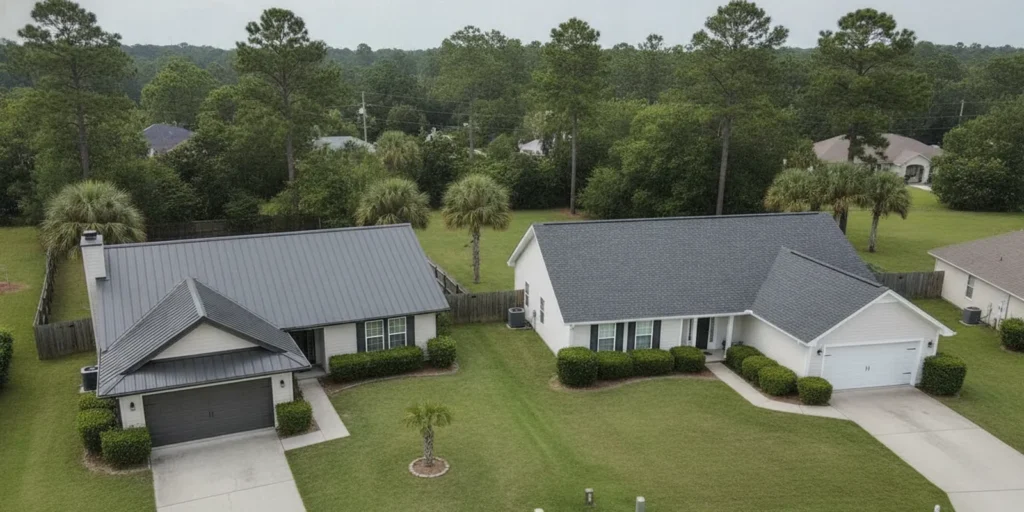
When homeowners compare metal roof vs shingles, the right choice depends on the roof in front of them, the exact systems being considered, and the priorities for the property. Metal and asphalt shingles are both used on homes, but neither is automatically the better choice for every roof. Start with the roof’s condition and design, then compare complete written proposals rather than choosing from a material name alone.
What does “metal roof vs shingles” really compare?
The phrase sounds like a choice between two simple products. In practice, it compares different roofing systems. “Metal” can refer to different panel profiles, finishes, fastening approaches, and related components. “Shingles” may refer to different asphalt shingle products and configurations. The material on the surface is only one part of the assembly.
A roof also depends on the supporting deck, underlayment, flashing, edge details, valleys, penetrations, transitions, and drainage. The way those parts meet is important. For example, a roof has to handle the places where a sloped plane meets a wall, where a chimney passes through the surface, and where water moves toward an eave or valley. A proposal that names a surface product but says little about these details leaves important questions unanswered.
It helps to clarify what each comparison is meant to answer. Are you choosing a look for a planned replacement? Responding to a leak? Reviewing damage after a storm? Preparing a home for sale? Managing a property where disruption and maintenance planning matter? The same two materials may be evaluated differently depending on the reason for the project.
Ask for the exact product and system under consideration, not only “metal” or “shingles.” Request manufacturer and product names where applicable, a description of included components, and an explanation of how the system suits the roof’s shape. If proposals describe different work, the totals do not offer a fair comparison.
Why begin with the roof’s condition?
A material comparison should not turn into an automatic replacement decision. A roof may need monitoring, a localized repair, further evaluation, or replacement. An inspection can help connect the next step to visible conditions. Age can provide context, but age alone does not establish that replacement is necessary.
Consider a homeowner who sees a water stain on a bedroom ceiling after rain. It is understandable to wonder whether a new metal roof or new shingles would solve the problem. But the stain is a symptom inside the home, not a diagnosis of the roof. The entry point might be near flashing, a penetration, a valley, or another area. The visible interior mark may not sit directly below the source. Replacing the entire covering without understanding the cause may not answer the most important question.
Now consider a roof with multiple visible concerns in several areas. The question may be whether repairs remain suitable or whether broader replacement should be evaluated. That answer depends on inspection findings and the roof as a whole, not a preference for one surface. A clear recommendation should explain what was observed and why the proposed scope follows from those observations.
Coastline Roofing’s inspection process is intended to examine accessible, visible roofing materials and relevant details such as flashing, penetrations, edges, drainage, and nearby areas associated with the concern, as access permits. Photographs can help explain findings. They do not show every concealed condition, so ask what was evaluated and what could not be seen. Learn more about the roof inspection process.
How should coastal Carolina conditions enter the decision?
For a home in the Grand Strand or southeastern coastal North Carolina, local exposure is a sensible part of the discussion. It is not a substitute for evaluating the specific roof. Location alone cannot establish that a particular system will perform a certain way or that one material guarantees protection. Roof shape, orientation, surrounding trees and buildings, existing condition, product details, installation, and water-management details all matter.
Ask the contractor to describe what is relevant about your property rather than making a broad statement about all coastal homes. For instance, ask whether the roof has complex valleys, wall intersections, or penetrations that need careful detailing. Ask how edges and transitions will be addressed. If a proposal makes a performance claim, ask which product information or documentation supports it and what qualifications apply.
Water movement deserves particular attention in any roof evaluation. Valleys collect water from adjoining planes. Eaves and edges define where water leaves the roof. Flashing helps address transitions and penetrations. Gutters and nearby drainage affect where water goes after it leaves the roof. These are not interchangeable parts, and changing the surface material does not by itself correct a poorly understood detail.
Suppose a homeowner sees staining near a wall and assumes the roof material is the cause. A useful assessment would identify the relevant transition, document what can be observed, and explain whether more evaluation is needed. If the concern can be addressed with a suitable localized repair, a material comparison may be premature. If the roof is otherwise being considered for replacement, the same transition should be included in the scope for either system.
Ask whether the recommendation is tied to observed conditions at this house. A general statement such as “metal is best for the coast” or “shingles are always enough” does not tell you what will be installed, how details will be handled, or why that option is appropriate. Look for an explanation specific to the roof.
When might a metal system be worth considering?
Metal may be worth evaluating when its appearance suits the home, the system fits the roof design, and its details align with the owner’s priorities. A homeowner may prefer a particular panel look or want to compare the available products with shingle options. The relevant task is to identify the actual system and its scope, not to assume that every metal roof is alike.
Ask what panel profile and product are proposed. Find out how the proposal describes fastening, panel edges, ridges, valleys, penetrations, and transitions. Ask what related components are included and how the installer will address areas where the roof meets walls or other structures. If samples or product documents are available, review them instead of relying on a broad category label.
There are practical design questions, too. How does the system work with the roof’s geometry? Are there areas with several intersecting planes, or a simple arrangement? What details are required around vents, chimneys, and other penetrations? Which parts of the project are included in the written scope? The answers should be specific enough that you can understand what is planned without having to infer the details from the word “metal.”
Do not treat the category as a promise of a particular service life, maintenance level, storm outcome, insurance result, or warranty. Product documents and applicable warranty terms govern those subjects. Workmanship warranties vary by installed system, and manufacturer material warranties have their own terms. Request the documents for the proposed system and review the conditions, exclusions, and responsibilities that apply.
Appearance is also personal. Compare actual product colors or finish samples in daylight and against the home’s siding, trim, and surroundings. A small sample can look different from a large roof plane. Consider the roof from the street and from the parts of the property where it is most visible. This is a preference exercise, not a technical proof of which system is suitable.
Metal might be an option to discuss for a planned replacement, but it should not be selected only because someone says it is inherently superior. The recommendation should account for roof condition, product details, installation scope, and the homeowner’s goals. The same careful questions apply if an owner is leaning toward shingles.
When might asphalt shingles be worth considering?
Asphalt shingles are a familiar residential roofing option, with product-specific profiles, colors, and installation requirements. The category still includes different products. Ask which product is proposed and what the written scope says about the complete assembly. Avoid comparing an unnamed shingle option with a detailed metal specification, or the reverse.
Look at the roof’s lines, adjoining exterior materials, and the appearance you want. Ask to review product information or samples for the specific shingle under consideration. A color that appears suitable on a small sample may look different across the roof. If appearance is important, take time to compare the available options rather than allowing a broad description to stand in for a product choice.
Ask how the proposal addresses removal, underlayment, flashing, edges, valleys, penetrations, and other transitions. A shingle product is not a complete answer to every roof condition. The details around it matter, just as they do with metal. Confirm what happens if conditions under the existing covering cannot be fully evaluated until removal.
A missing or damaged shingle does not, on its own, establish that the entire roof requires replacement. The location and extent of the damage, the condition of the surrounding roof, and the feasibility of a suitable repair all matter. Coastline Roofing performs roof repairs, and the roof repair information explains that localized work may be considered when the broader roof remains serviceable.
Conversely, a small visible defect does not prove that the rest of the roof is in good condition. Inspection findings should distinguish what is known from what needs further evaluation. That is why the choice between repair and replacement should follow an assessment, rather than a quick assumption based on one visible spot.
Which factors should you compare first?
A useful comparison starts with what the owner needs from the project. Write down the reason for considering work, what has been observed, and what matters most. Priorities might include resolving a specific concern, coordinating work around property use, selecting an appearance, understanding the full scope, or reviewing warranty documents. No one priority should be assumed to matter most to every owner.
Condition and scope
Start with the findings. Is the concern localized, or are there observations across multiple areas? Is the source clear, or does it need more evaluation? Does the roof appear suitable for monitoring or repair, or is replacement being recommended? Ask the contractor to show the relevant areas in photographs where possible and explain why the recommended work fits them.
Then separate the known scope from possible concealed conditions. For a replacement, some parts of the deck may be hidden until the existing covering is removed. Ask how the exposed deck will be assessed, how any change in conditions will be documented, and how approval will be obtained before additional work proceeds. This process matters regardless of the chosen material.
Roof shape and details
Roof area is only one aspect of a project. The number and arrangement of planes, valleys, ridges, edges, penetrations, and wall connections can affect the work involved. A simple roof and a roof with many intersections may require different detailing. Ask how the proposal accounts for the particular shape rather than relying on a general description.
Walk through the roof’s visible features with the contractor if it is safe and practical to do so from the ground or another accessible location. Point out chimneys, vents, skylights, wall intersections, low-slope transitions, and known leak areas. You do not need to climb onto the roof. A qualified inspection can document relevant findings and explain what can be assessed safely.
Product information
Ask for the manufacturer and exact product names where applicable. Confirm the proposed color or finish, configuration, and included components. If a contractor discusses durability or performance, ask for the product documentation that supports the statement and read the qualification language. General terms such as “premium,” “heavy duty,” or “coastal grade” should be made concrete in a written proposal.
Product documents can help you distinguish what a manufacturer says about its product from what a contractor proposes to install. Keep the documents with the estimate. If the chosen product changes, ask for updated details and confirm whether any related parts of the scope change as well.
Installation details
Compare how each proposal describes removal and preparation, underlayment, flashing, edges, transitions, and the work around penetrations. Ask what protection is planned for the property and how cleanup will be handled. If an item is excluded or dependent on conditions, make sure that is stated clearly.
Do not assume two proposals are equivalent because both say “complete roof replacement.” One may include details or components that the other leaves unclear. Ask the contractors to explain differences line by line. If a scope uses a broad phrase, request a plain-language explanation of what the crew will do.
Warranty documents
Warranties are not interchangeable labels. Ask which workmanship warranty applies to the proposed installation and which manufacturer material warranty documents apply to the products. Review who provides each warranty, what it covers, how long its stated terms apply, and which exclusions or maintenance conditions are listed. Do not infer a universal duration from the material category or assume a contractor credential automatically provides a particular warranty.
Keep the actual written documents rather than relying only on a conversation. If two systems have different warranty documents, compare their conditions carefully. Ask how to contact the responsible party if a future question arises and what records you should retain. The goal is to understand the terms, not simply compare the largest-sounding claim.
Schedule and property access
Ask what factors may affect the schedule for this specific job. Material availability, roof complexity, weather, and hidden deck repairs can change the work plan. Most residential replacements are described as finishable within a few days only conditionally; that is not a guarantee, a booking lead time, or a commercial project schedule. Ask what the contractor can say about the particular proposal and how changes will be communicated.
Think through practical access questions, such as where workers and materials may need to be positioned and what parts of the property should be kept clear. Do not assume every job has the same site plan. For a managed, multifamily, HOA, or commercial property, request a scope specific to that building and its circumstances rather than applying a residential process automatically.
How do you compare written estimates fairly?
There is no reliable material-only price comparison that applies to every roof. Replacement estimates depend on roof size and complexity, system choice, scope, access, and the deck condition discovered after tear-off. Coastline Roofing does not publish fixed roof prices or price ranges. The useful comparison is between written proposals that describe equivalent work for the particular property.
Begin by putting the proposals side by side. Note the product and components listed, removal and preparation, underlayment, flashing, edge and transition work, cleanup, and any exclusions. Record what each contractor says about concealed deck conditions and the process for documenting and approving additional work. If one proposal includes a clear description and another does not, ask for clarification before comparing totals.
Here is a practical way to organize the review:
- Identify the system. Write down the exact manufacturer and product information provided, the surface material, and any specified components. Mark anything described only in general terms.
- Compare preparation. Check whether removal and disposal of the existing covering are described, what preparation is included, and whether the scope says how the exposed deck will be examined.
- Compare water-management details. Look for descriptions of underlayment, flashing, valleys, eaves, penetrations, edges, and transitions. Ask what applies to the roof’s actual features.
- Mark exclusions and allowances. Note work that is excluded, conditional, or dependent on concealed conditions. Ask how the amount or scope of any change will be explained and approved.
- Review cleanup and protection. Ask what the proposal says about protecting the property, handling removed material, and completing cleanup.
- Review documentation. Collect product information, workmanship and manufacturer warranty documents, and any photographs or findings that support the recommendation.
- Ask about schedule factors. Confirm which circumstances might affect this project and how the contractor will communicate a change.
This comparison can reveal why two totals differ without treating a lower or higher number as proof of better work. One estimate may include a different product, more detailed scope, or a different approach to concealed conditions. Another may omit details that have not yet been clarified. Ask for explanations in writing so that your decision is based on the proposed work rather than assumptions.
For example, imagine one proposal specifies a particular system and lists removal, underlayment, flashing, and cleanup, while another simply says “install metal roof.” Those descriptions are not yet equivalent. The next step is not to guess which contractor will do more. Ask the second contractor to clarify the system and scope, and ask the first to explain any exclusions. Only then can you judge which proposal better fits the property and your priorities.
Qualified homeowners may explore financing for eligible replacement projects, subject to lender approval and terms. Financing is not a promise of approval and does not apply automatically to repairs, inspections, or commercial work. If it is relevant to your decision, ask for the current details and review the applicable lender terms directly.
What if you have a leak or visible damage now?
If water is entering the home, begin with safety and useful documentation. Avoid climbing onto a wet roof or entering an unsafe area. If practical, note when the water appeared, what the weather was like, where you see symptoms indoors, and whether the area changes over time. Photos from a safe location can help describe the concern, but they do not identify the roof entry point by themselves.
Tell the roofing contractor what you have observed and whether the issue is active. A roof evaluation can consider the visible covering and relevant areas around flashing, penetrations, and drainage, as access permits. The investigation may find a localized issue, or it may indicate that more assessment is needed. Ask what the contractor could inspect and what could not be confirmed from the available access.
A repair may be appropriate when damage is localized and the surrounding roof remains serviceable. The extent of damage, source, materials, and access all affect the repair scope. A replacement should not be presented as the only answer simply because the homeowner is already comparing metal and shingles. Ask the contractor to explain why the rest of the roof does or does not support a repair approach.
After a storm, Coastline can document visible damage and recommended roofing work. The insurance carrier decides coverage. A contractor cannot promise that a claim will be approved or determine coverage on behalf of the carrier. If storm damage is the reason for the comparison, keep the assessment, photographs, and any carrier communications organized, and review the process described on the storm damage roofing page.
A homeowner preparing to sell or buy may also want an inspection to understand visible roof conditions. Be clear about the purpose of the inspection and ask what it covers. A roofing evaluation is not a substitute for other property assessments, and no photograph can reveal every concealed condition. If the inspection identifies an issue, ask whether it calls for monitoring, repair, further evaluation, or replacement.
What should you ask during an inspection?
A useful inspection conversation should leave you with an understandable account of the roof’s condition and next step. You can prepare a short list before the visit. It is not necessary to know roofing terminology. Describe what you have noticed and ask the contractor to explain findings in plain language.
- What areas were evaluated, and what could not be accessed or seen?
- Which observations are connected to the concern I reported?
- Can you show me photographs of relevant visible findings?
- Does the evidence point to a localized repair, monitoring, further evaluation, or replacement?
- If you recommend replacement, what findings make repair unsuitable or insufficient?
- Which exact products and components would each proposed system include?
- How would the roof’s valleys, edges, wall connections, flashing, and penetrations be addressed?
- What conditions may remain concealed until existing material is removed?
- How will changed conditions be documented, explained, and approved?
- What warranty documents apply to the installed system and its materials?
- What schedule factors are specific to this home?
Listen for a connection between the recommendation and the evidence. A contractor should be able to distinguish observed conditions from assumptions and explain why a specific action fits. If an answer is unclear, ask for a written explanation or photographs. It is reasonable to seek another assessment when you need more information before authorizing a major project.
Photographs are useful, but they have limits. They show visible details from particular views and times; they do not automatically reveal what is under a roof covering or what lies beyond an inaccessible area. Ask the inspector to state those limits. A candid description of what could not be confirmed can be more useful than a sweeping conclusion.
How should property owners and managers adapt the comparison?
The metal-versus-shingles question is often framed around a single-family home, but property owners, managers, and HOA boards may also be evaluating roof work. The same basic principles apply: understand the observed condition, identify the exact system, compare a complete scope, and document what remains uncertain. The decision should be specific to the building rather than borrowed from a residential example.
For a multifamily or managed property, the roof may cover several units or connect to shared building elements. A contractor should explain the areas evaluated and the scope proposed for that building. Do not infer tenant-notice requirements, board approvals, procurement steps, or project phasing from a general article; those depend on the owner’s or association’s own requirements. Ask for the details necessary to evaluate the building and coordinate its project responsibly.
Commercial buildings can have different roof forms and system needs from homes. Coastline Roofing offers commercial roofing, including TPO work, but this does not mean a particular commercial property should receive a residential metal or shingle recommendation. Ask for a building-specific assessment and scope. Commercial project timing, access, drainage, and system specifications should be discussed for that property, not inferred from a residential replacement.
Property decision-makers may benefit from keeping a clear record of inspection findings, photographs, proposed scope, product information, exclusions, approvals, and completed work. The records make it easier to understand what was recommended and what was authorized. They also help prevent confusion if proposals use different names for similar areas or components. Store the final warranty documents with the project file.
When comparing proposals for a larger property, make a list of questions that are relevant to the building and ask each contractor to respond to the same points. That can make the comparison more consistent. It does not replace the owner’s procurement or approval process, and it does not determine which material is right. It simply helps clarify what each contractor is proposing.
Which common assumptions should you question?
“The roof is old, so it must be replaced.”
Age is context, not a standalone diagnosis. Condition, observed damage, the roof’s overall serviceability, and the owner’s goals all matter. An inspection may lead to monitoring, repair, further evaluation, or replacement. Ask what evidence supports the recommendation rather than treating a calendar age as a decision by itself.
“A leak means I need a new roof.”
A leak means the source should be investigated. It may be related to a localized detail, but the interior symptom alone does not identify the entry point or the condition of the full roof. A suitable repair may be possible if the surrounding roof remains serviceable. Ask for the basis of any recommendation for broader work.
“Metal always wins near the coast.”
That statement is too broad to decide a particular project. Products, roof design, installation details, condition, and owner priorities matter. Ask how the proposed system fits the roof and what documentation supports any specific performance statement. A material label is not a substitute for that explanation.
“Shingles are all the same.”
Products and installation details vary. Ask for the specific shingle product and the complete assembly being proposed. Review its documents and confirm how the details on your roof will be handled.
“The lowest total is automatically the best deal.”
A total does not show whether proposals include equivalent products, components, preparation, flashing, cleanup, or treatment of concealed conditions. Clarify differences before drawing a conclusion. The goal is to compare complete scopes and choose one that addresses the property’s needs.
“A warranty headline tells me everything.”
Ask to read the actual workmanship and manufacturer warranty documents. Coverage, terms, exclusions, and responsibilities matter. Do not assume a universal duration or that a credential automatically establishes a particular warranty or resilience designation.
“An inspection guarantees a particular outcome.”
An inspection reports what can be evaluated and may recommend monitoring, repair, further evaluation, or replacement. Hidden conditions may not be visible before removal, and access can limit what is assessed. Ask what the findings establish and what remains uncertain.
What does a careful decision process look like?
You can make the comparison manageable by following a sequence. This keeps the material decision in its proper place: after you understand the condition and before you authorize work.
- Write down the reason for the project. Note whether you are responding to a leak, visible damage, storm concerns, a planned replacement, a purchase or sale, or another issue. Describe what you have seen, when it began, and what changes you have noticed.
- Arrange an inspection or appropriate assessment. Share the concern and ask what areas can be evaluated safely. Do not climb on a wet or unsafe roof to collect information.
- Review the findings. Ask for photographs where useful, a description of observed conditions, and a clear account of any limits. Separate confirmed findings from possible concealed conditions.
- Confirm the appropriate next step. Ask whether monitoring, repair, further evaluation, or replacement is supported by the findings. If replacement is proposed, ask why a repair is not suitable for the roof as a whole.
- Define your priorities. Identify appearance, system details, project scope, schedule considerations, documentation, and warranty terms that matter to you. For a managed or commercial building, identify the property-specific questions that need answers.
- Request exact system information. Compare actual products and components, not generic material labels. Ask how each option addresses the roof’s edges, valleys, transitions, flashing, and penetrations.
- Compare proposals line by line. Check removal, preparation, underlayment, flashing, cleanup, exclusions, and the process for hidden deck conditions. Ask for clarification wherever a scope is vague.
- Review documents before authorizing work. Read warranty materials and product information. Confirm what work is included and how any change will be handled and approved.
- Keep a project record. Save the assessment, photographs, proposal, approvals, product documents, and final warranty information in one place.
This process does not force a choice in advance. It gives you a way to distinguish a material preference from a roof need. If a roof is suitable for a localized repair, a replacement comparison may not be necessary now. If replacement is supported, a clear scope makes it easier to compare metal and shingle systems on the details that matter for your home.
How can you work through realistic comparison scenarios?
Examples can make the decision process easier to apply. These are general scenarios, not findings about a particular home. The right recommendation still depends on an assessment of the actual roof and the products proposed.
A small ceiling stain appears after heavy rain
A homeowner notices a round stain near an upstairs ceiling after a period of rain. The first impulse may be to compare replacement materials, especially if the roof has not been evaluated recently. A better first step is to record when the stain appeared, whether it grows, and whether it recurs during particular weather. Take a photograph from a safe indoor location and note the room and approximate position. Do not assume that the roof entry point sits directly above the stain.
When arranging an assessment, explain the symptom and ask the inspector to examine relevant visible roof details as access permits. The inspection may identify a localized issue, or it may show that further evaluation is needed. If a repair is recommended, ask what it addresses and whether the surrounding roof appears serviceable. If a replacement is recommended, ask what broader findings support that scope. Only after the condition and appropriate scope are understood does it make sense to weigh metal and shingles for a replacement.
A homeowner is planning a replacement without an active leak
Another owner may be planning ahead because the existing covering is visibly worn or because they want to consider a different appearance. In that case, an inspection can establish the visible condition and identify details that should shape the scope. The homeowner can also list preferences before comparing systems: colors, surface appearance, product information, project documentation, and questions about warranties.
Ask for proposals that identify exact systems and explain the same major work categories. If one contractor proposes shingles and another proposes metal, the comparison should still include preparation, flashing, edges, transitions, cleanup, and concealed-condition procedures. A preference for a particular look is valid, but it does not replace asking whether the proposed system fits the roof design and how it will be installed.
A roof has one damaged area after a storm
A visible area of damage after a storm does not automatically establish the condition of every other roof plane. Document what can be seen safely and request an assessment. Coastline may photograph visible damage and recommended roofing work, while the carrier independently decides insurance coverage. Keep those two questions separate: what roofing work is recommended, and what coverage decision the carrier makes.
If the assessment finds a localized issue and the surrounding roof is serviceable, ask whether repair is suitable. If findings extend beyond one area, ask for a clear explanation and photographs where possible. A decision between repair and replacement comes before choosing the replacement material. If replacement becomes appropriate, then compare the specified metal and shingle systems and their written scopes.
A property manager is comparing proposals for a building
A manager may need to understand a proposal for a multifamily or commercial building without assuming that a single-family home process applies. Request a building-specific description of the areas assessed, the observed conditions, the system proposed, and the work included. Ask contractors to respond to the same project questions so that the proposals can be reviewed consistently. The owner or association should apply its own procurement, approval, and communication requirements; a general roofing article cannot establish those policies.
For a commercial property, ask about the system appropriate to that building rather than treating residential metal and shingle examples as a complete commercial comparison. Coastline performs commercial roofing, including TPO work, but each property needs its own assessment and scope. Ask what documentation, access, drainage details, and schedule assumptions apply to the specific project, without assuming an unverified timeline or process.
How can you keep the decision organized?
A simple project file helps prevent details from getting lost while several options are considered. Start with a short record of the concern or goal, date of the inspection, and the areas the contractor says were evaluated. Add photographs with brief captions, such as “north-facing eave” or “stain in upstairs room.” Captions should describe the location, not diagnose the cause unless the contractor has identified it.
Next, maintain a proposal comparison sheet. Use one row for each question and one column for each contractor or system. Record exact product names, preparation and removal, underlayment, flashing, edges, penetrations, cleanup, exclusions, concealed-condition procedures, schedule factors, and warranty documents. Use “not specified” rather than filling gaps with assumptions. That notation gives you a precise follow-up question.
For example, if one proposal lists work at valleys and wall transitions but another does not mention them, write “clarify valley and wall-transition scope” beside the second proposal. Do not assume that a missing phrase means the work is excluded, and do not assume that it is included. Ask the contractor to make the scope clear in writing. This makes the comparison more useful and reduces the chance that two different proposals are treated as equivalent.
Keep a separate note of any conditional items. A proposal may describe work that depends on what is found after removal. Record the contractor’s stated method for showing the condition, documenting it, explaining the proposed change, and receiving approval. If you do not understand the process, ask before authorizing the job. The goal is to know how a new observation will be handled, not to predict concealed conditions in advance.
Finally, keep the final agreement and documents together. Save the accepted scope, written approvals for changes, product information, photographs, and applicable warranty materials. If a question arises later, those records help identify what system was installed and what was included. For a managed property, follow the owner’s own recordkeeping and approval practices, and do not assume that a residential file format is sufficient.
What does a recommendation tied to evidence sound like?
A useful recommendation typically explains three things: what was observed, why it matters, and what next step follows. For instance, it might identify a visible area of concern, explain whether the inspection could evaluate surrounding details, and say whether repair or further assessment is appropriate. If replacement is proposed, the explanation should identify the broader findings that make that option relevant.
By contrast, a recommendation based only on a slogan leaves questions unanswered. “This material is always best” does not identify the product, the roof condition, or the installation details. “Your roof is old” does not describe observed damage or explain whether repair remains possible. “A storm means the insurer will pay” oversteps the roofing assessment because the carrier determines coverage. Ask for the factual basis and the limits of the conclusion.
It is reasonable to ask a contractor to distinguish certainty from possibility. A visible condition may be clear, while the underlying cause or extent may require more access or removal to confirm. The written proposal should indicate where that uncertainty exists and how it will be addressed. This makes it easier to compare actual commitments without expecting an inspection to reveal concealed conditions it cannot see.
When the explanation is clear, the owner can make an informed next decision without being pressured into choosing a material prematurely. If the outcome is monitoring, ask what signs should prompt another evaluation. If it is repair, ask what area and concern the work addresses. If it is replacement, compare exact systems only after understanding the scope and rationale.
What information should you gather before asking for proposals?
You do not need to prepare a technical report. A few practical observations can help a contractor understand why you are reaching out. Note the type of concern, when it began, whether it has happened more than once, and which rooms or exterior areas are involved. If you have prior roof documents or photographs, gather them, but do not treat old records as proof of the roof’s current condition.
Make a list of known work or changes, if any: a previous repair, a known leak, a replaced vent, or an area that has been difficult to access. State what you know and what you do not know. Avoid guessing at a cause. If the issue followed a storm, note the approximate date and what you observed from a safe location. This context can help focus the conversation, though it does not establish insurance coverage.
For a planned replacement, consider what questions matter most to you before the estimate visit. You might want to understand color options, product documentation, project protection, the treatment of concealed deck conditions, or warranty terms. A concise priority list helps ensure the proposal discussion addresses your needs. It also helps you compare contractors on the same issues rather than being swayed by whichever proposal uses the most persuasive shorthand.
For commercial, multifamily, managed, or HOA property, identify the building and the area of concern, and ask what information the contractor needs to prepare a property-specific assessment. The responsible property owner or organization should explain any applicable access or approval requirements. Do not assume an online request creates a reserved appointment or that a contractor’s standard residential scope includes the building’s organizational requirements.
Frequently asked questions
Is a metal roof always a better choice for coastal Carolina?
No. A location does not determine the answer by itself. Product, roof design, installation details, condition, and owner priorities matter. Ask for a recommendation tied to the roof’s observed conditions and the exact system proposed.
Does one leak mean the whole roof needs replacement?
Not necessarily. A leak should be investigated to identify the likely source and assess the surrounding roof. A localized repair may be appropriate when the broader roof remains serviceable. Ask the contractor to connect any replacement recommendation to specific findings.
Which option costs less?
There is no universal answer based only on the words metal and shingles. Estimates depend on the roof’s size and complexity, selected system, scope, access, and deck condition discovered after tear-off. Compare written proposals describing equivalent work, and ask what is excluded or conditional.
Can I choose a material before an inspection?
You can develop preferences about appearance and products, but an inspection can help establish whether the roof needs work and what type of work is appropriate. Knowing the condition first can prevent a material preference from driving an unnecessary replacement decision.
What if the deck condition changes during replacement?
Some conditions may remain concealed until existing roofing is removed. Before work begins, ask how the exposed deck will be assessed, how findings will be documented, and how a proposed change in work will be explained and approved. Review the written proposal for its process and any relevant conditions.
Does a storm assessment mean the insurance carrier will pay?
No. Coastline can document visible damage and recommended roofing work, but the insurance carrier decides coverage. No contractor can promise a claim outcome. Keep the assessment and carrier communications organized and ask questions about the carrier’s process directly.
Choose the system after understanding the roof
Metal and asphalt shingles can both be options worth discussing for a residential replacement. Start with the roof’s condition, compare exact systems and written scopes, and ask how the proposed work addresses the details on your property. A leak, an old roof, or a preference for one appearance does not by itself establish that full replacement is needed. Coastline Roofing serves Myrtle Beach, North Myrtle Beach, Little River, Longs, Conway, surrounding Grand Strand communities, and southeastern coastal North Carolina. Call 843-877-2296 to schedule an inspection and discuss the next step based on what is found.
For general roofing education, the National Roofing Contractors Association is an industry association resource; product documents and a property-specific assessment are still needed to understand how general information applies to your roof.